
Vol. 8 No. 1 (2014): January
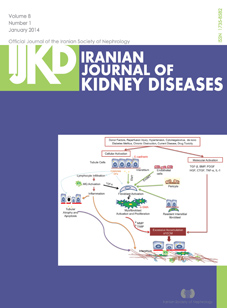
About the cover:Mechanisms and mediators of renal interstitial fibrosis and tubular atrophy (IFTA).Immunological (acute rejection, previous transplantation, HLA mismatch) and nonimmunological (donor’s age, source, reperfusion injury, hypertension, diabetes, chronic obstruction, bacterial pyelonephritis, viral nephritis, and drug toxicity) factors trigger renal fibrosis. Transforming growth factor-β induces matrix production through Smad3-dependentpathway and inhibits extracellular matrix degradation by suppressing MMPs and inducing the inhibitor of matrix metalloproteinases (tissue inhibitor of metalloproteinases). Moreover, it induces myofibroblast formation through tubular epithelial–mesenchymal transition. Cellular (epithelial-mesenchymal transition, fibroblast activation, lymphocyte infiltration, and cellular apoptosis) and molecular activations lead to the excessive accumulation of ECM. TGF-β indicates transforming growth factor-β; BMP, bone morphogenetic protein; PDGF, Platelet-Derived Growth Factor; HGF, hepatocyte growth factor; CTGF, connective tissue growth factor; TNF-α, tumor necrosis factor alpha-α; IL-1, interleukin 1; EMT, epithelial-mesenchymal transition; EndMT, endothelial-to-mesenchymal transition; and SMA, smooth muscle actin; MMP, matrix metalloproteinases; TIMP, tissue inhibitor of metalloproteinase; and ECM, extracellular matrix.